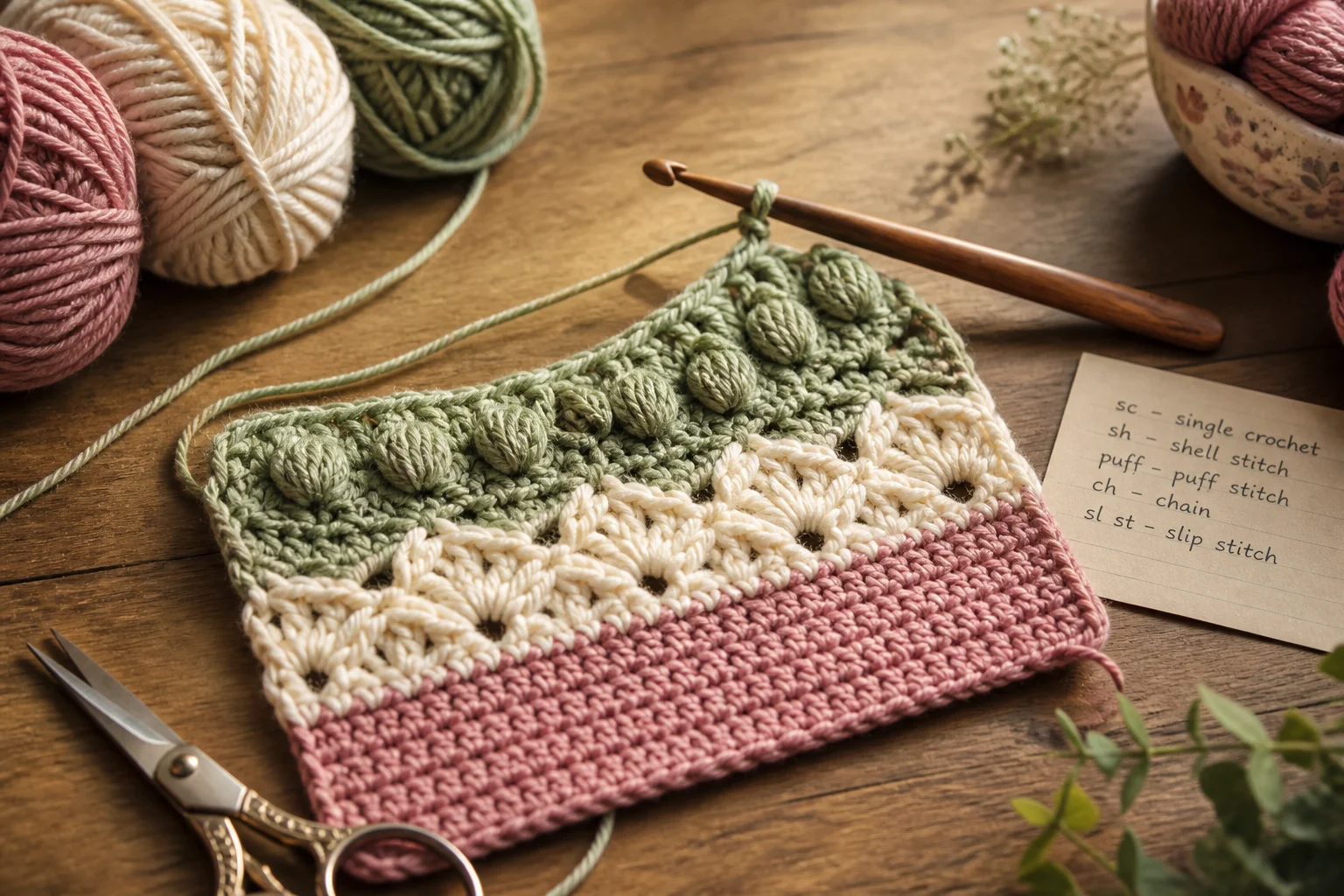
Look up a stitch, then get back to crocheting
This crochet stitch dictionary is a practical reference, not an exhaustive catalog of every stitch ever invented. Use it to identify a stitch abbreviation mid-pattern, understand what a stitch name actually means, and pick a texture that fits your next project instead of guessing.
You will find a quick reference list of standard abbreviations, a plain US-to-UK conversion so pattern terms stop feeling like a second language, and concise tutorials for the six foundational stitches written in US terms. From there, you will see how those basics combine into named stitch patterns like moss stitch or shells, and how to weigh density, drape, and texture when deciding what to make next.
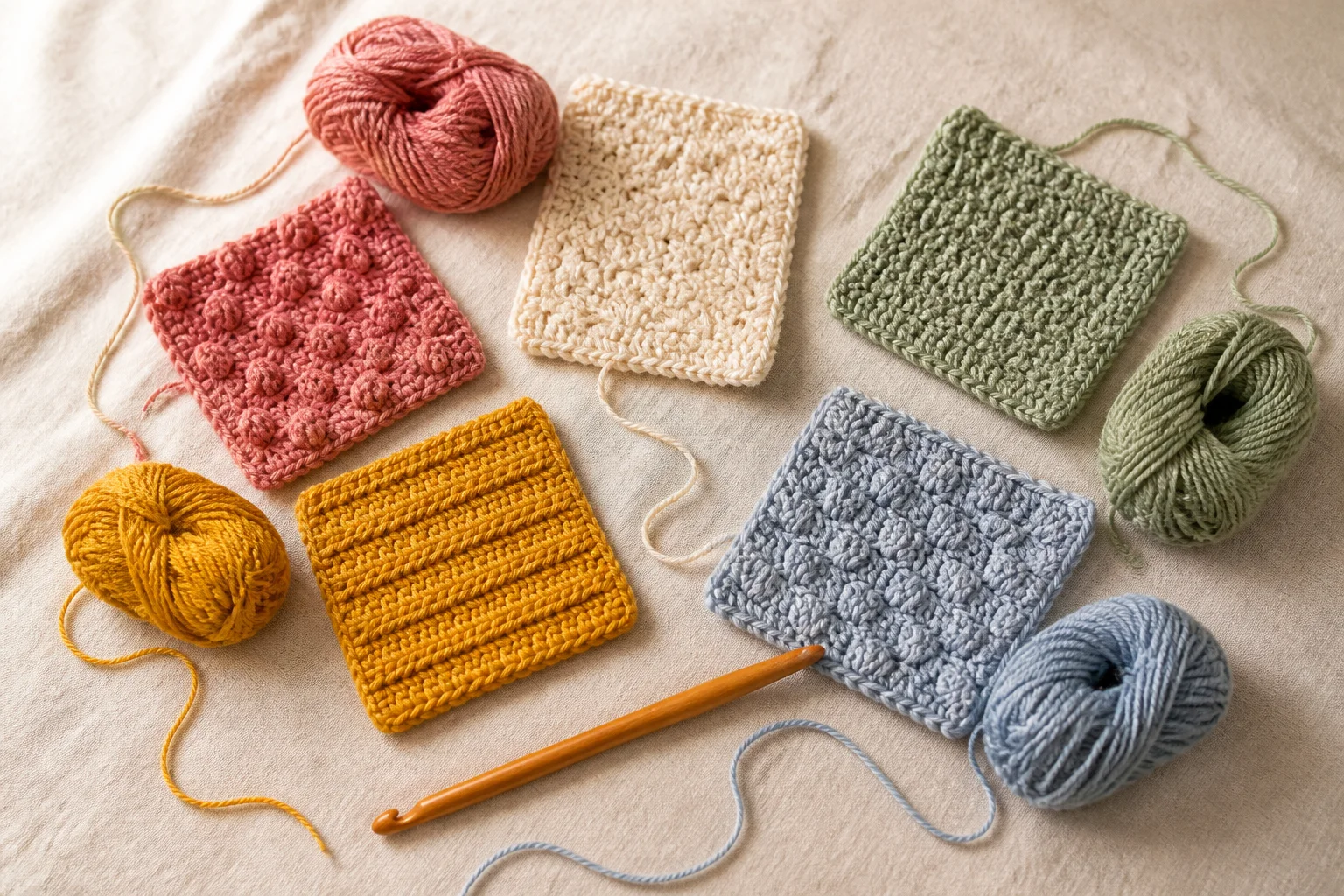
Quick reference: abbreviations and US to UK terms
Every instruction in this guide uses US terminology, so it helps to know the six abbreviations you'll see again and again:
- chain (ch)
- slip stitch (sl st)
- single crochet (sc)
- half double crochet (hdc)
- double crochet (dc)
- treble crochet (tr, sometimes trc)
These match the Craft Yarn Council's standard crochet abbreviations, which most US pattern designers follow.
If you pick up a pattern written in UK terms, the names shift even though the stitches themselves stay recognizable:
- UK double crochet (dc) is US single crochet (sc)
- UK half treble (htr) is US half double crochet (hdc)
- UK treble (tr) is US double crochet (dc)
- UK double treble (dtr) is US treble crochet (tr)
- UK slip stitch keeps the same name but is often abbreviated ss instead of sl st
The catch is that identical words point to different stitches depending on where the pattern was written, so don't assume "double crochet" means the same thing in every source. If a pattern doesn't state its terminology up front, check for sc or hdc, which only exist in the US system, or htr, which is UK-only.
One more thing varies by pattern rather than by country: turning chain height and whether that chain counts as a stitch. Some designers count a starting chain-3 as a stitch in the row; others don't. Always follow what the individual pattern specifies rather than assuming a universal rule.
Crochet stitch dictionary: six foundational tutorials
Two phrases show up in every instruction below. Yarn over means wrapping the yarn over your hook once, from back to front. Pull up a loop means inserting the hook where directed, catching the yarn, and drawing it back through so a new loop sits on the hook. Once those feel automatic, the six basics fall into place.
Chain (ch). Yarn over and pull through the loop already on your hook. One loop remains after each chain. Repeat to build your foundation row.
Slip stitch (sl st). Insert the hook into the stitch, yarn over, then pull through both the stitch and the loop on your hook in one motion. One loop remains. Used for joining rounds or moving across stitches without adding height.
Single crochet (sc). Insert the hook, yarn over, and pull up a loop [2 loops on hook]. Yarn over again and pull through both loops. When starting from a foundation chain, skip the first chain from the hook and insert into the second chain.
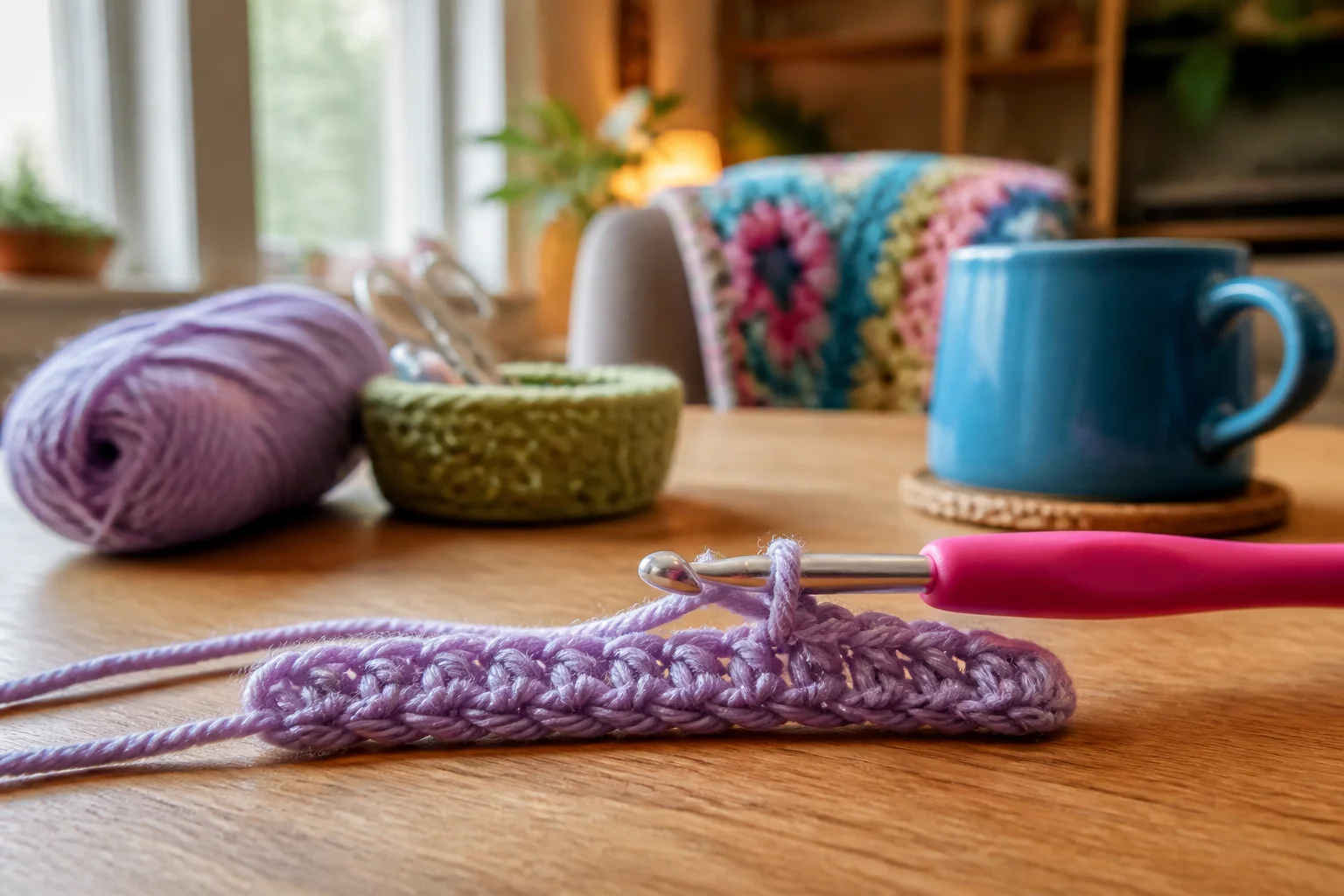
Half double crochet (hdc). Yarn over, insert the hook, yarn over and pull up a loop [3 loops on hook]. Yarn over once more and pull through all three loops at once. Hdc sits between sc and dc in height.
Double crochet (dc). Yarn over, insert the hook, pull up a loop [3 loops on hook]. Yarn over and pull through two loops, then yarn over and pull through the remaining two loops.
Treble crochet (tr). Yarn over twice, insert the hook, pull up a loop [4 loops on hook]. Yarn over and pull through two loops, three times in a row, until one loop remains.
Stitch height depends on both the yarn overs and how you finish the stitch. Hdc and dc each begin with one yarn over; hdc pulls through all three loops together, while dc finishes in two pull-through steps. Treble begins with two yarn overs and finishes in three pairs.
Turning chain height changes with the stitch you're working and sometimes with the pattern designer's own preference, so check the pattern notes rather than assuming a fixed rule for every project.
Combining stitches for texture and pattern
Once you know the six basics, most textured fabrics turn out to be those stitches arranged in a repeating shape. A stitch name often describes a family of similar arrangements rather than one locked formula, so two patterns both called "shell stitch" can use a slightly different stitch count.
Moss stitch (linen stitch) alternates single crochet with chain-1 spaces, skipping a stitch each time to leave a gap. The next row works sc into the previous row's chain space and chains over the sc below, building the woven look moss stitch is known for. Check your pattern's stated chain multiple before starting, since some Yarnspirations moss-stitch blankets use a 2-plus-2 multiple.
Granny stitch commonly groups three double crochet in a space, then places the next row of groups in the gaps between groups below. Some versions add chains between groups and others do not. Granny squares need separate corner instructions, often with two groups and a chain space in each corner. Follow the complete pattern for its spacing and shaping.
Shell stitch gathers several stitches into one spot to fan out, such as (1 dc, ch 1) three times, then 1 dc in the same stitch, producing a scalloped edge.
V-stitch commonly places (dc, ch 1, dc) in one stitch or space. Subsequent rows often place each V in the chain space of the V below. Some variations omit the chain or change the spacing, so use the foundation multiple and edge instructions for your specific version.
Ribbing places single crochet or half double crochet into the back loop only of each stitch, leaving the front loop as a visible ridge and giving the fabric stretch similar to knit ribbing.
Puffs, bobbles, and popcorns get confused constantly. A puff gathers several elongated, unfinished loops on the hook before pulling through them all at once. A bobble joins several partially completed taller stitches at their tops. A popcorn completes each stitch fully, then folds and closes the group afterward, giving it a firmer, more defined bump. Counts and heights vary by designer, so follow the pattern's own directions over any general rule here.
Matching stitches to what you're actually making
Choose a stitch by the fabric you need. Single crochet often suits compact amigurumi fabric; half double crochet is useful for cozy accessories. Double and treble crochet add height quickly and can produce more open fabric. Moss stitch offers a subtle woven texture, while granny and V-stitch suit open blankets and wraps. Shells add scalloped details, and back-loop ribbing is useful for cuffs and brims. Puffs, bobbles, and popcorns can add substantial texture and yarn usage, whether used as accents or across a whole project. Yarn, hook, and tension affect all of these results, so assess a swatch before committing.
None of this is a strict rulebook. Your yarn choice and hook size shift density, drape, and stretch as much as the stitch itself, so treat this crochet stitches guide as a starting point for testing, not a fixed formula.
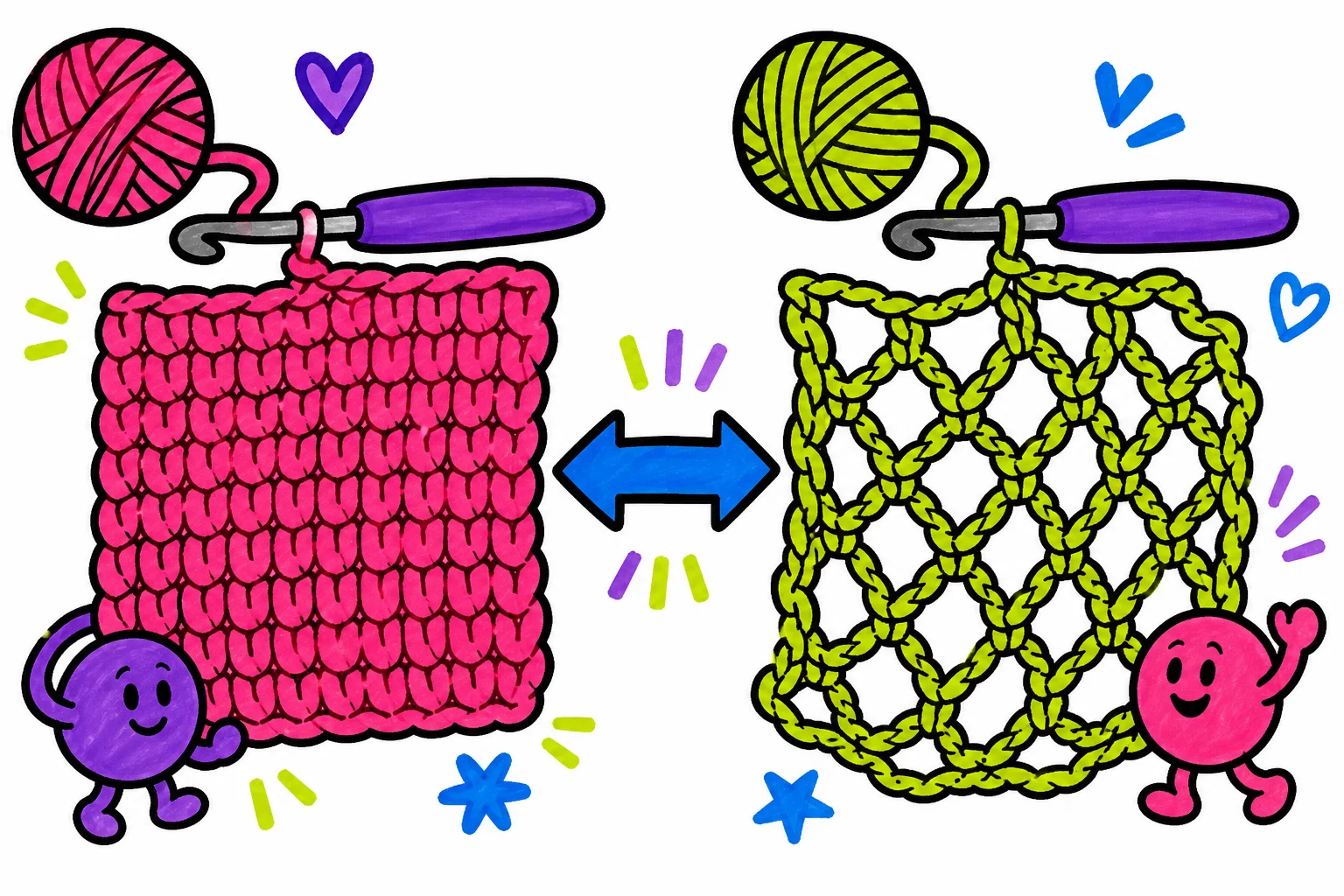
Making a swatch that actually tells you something
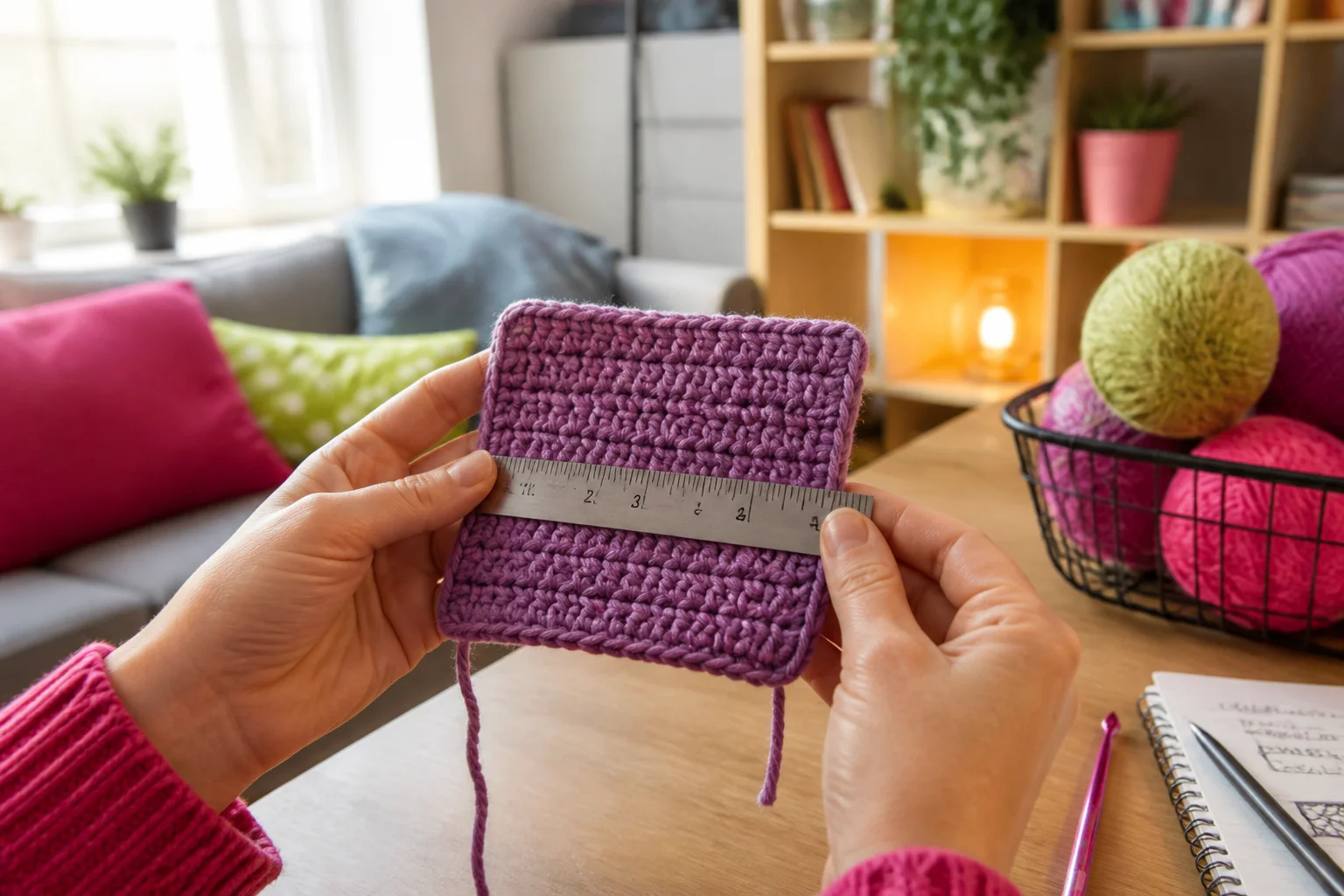
Before committing to a full project, make a swatch at least 5 to 6 inches square using your intended yarn, hook, and stitch pattern. Wash and dry it as the finished item will be treated, following the yarn care instructions and any blocking instructions in the pattern. Measure a central 4-inch area without stretching the fabric. Count stitches and rows within that span, including fractions at the measurement boundaries, and compare with the stated gauge. More stitches per 4 inches means your stitches are smaller: try a larger hook. Fewer means they are larger: try a smaller hook. Make and measure a fresh swatch after changing hooks; check row gauge as well as stitch gauge.
While swatching, mark your first and last stitch in every row to catch accidental widening or narrowing at the edges, a common problem when the turning chain gets treated inconsistently. Missed chain spaces, uneven tension, or very dense stitching can leave fabric stiff or prone to curling. If a row is off by only a stitch or two, frogging back to the last correct row usually fixes it without starting over.
Answers to a few common stitch questions
Which crochet stitch should a beginner learn first?
Start with chain and single crochet. Practice recognizing the top of each stitch and counting a straight row before adding taller stitches.
Does the turning chain count as a stitch?
Follow the pattern notes. A chain-1 for single crochet usually does not count, while taller turning chains often do. Consistency at both row edges prevents accidental increases or decreases.
Why do the same crochet stitch names have different instructions?
Many names describe a stitch family. Shells, puffs, and bobbles can use different stitch counts or closure steps. The pattern’s special-stitch definition takes priority over a general dictionary.
Can I substitute one crochet stitch for another?
Sometimes, but the replacement changes stitch and row gauge, drape, dimensions, and yarn use. It is easiest to experiment on a simple rectangle. Fitted garments and shaped toys need more careful recalculation.
Ready to practice? Browse curated patterns on Derpy Monster and pick a project to try your new stitch on.
Written by
Adriana Maronese
I’m Adriana, the maker behind Derpy Monster. I love learning, making, and sharing the little discoveries that make crochet feel more joyful.
Keep the making going
What do you feel like making today?
Find your next pattern, collection, or tiny spark of inspiration.