
Getting your bearings on crochet hooks
Crochet hooks vary in four ways: head shape, material, handle design, and size. Once you know those four categories, every hook on a store shelf or in your grandmother's sewing basket makes sense.
None of these categories has one correct answer. A hook that feels great in one crocheter's hand can feel awkward in another's, and the yarn, pattern, and project push you toward different choices. A lace doily wants a different hook than a chunky blanket, and your own hands get a vote too.
Here's a quick comparison before the details.
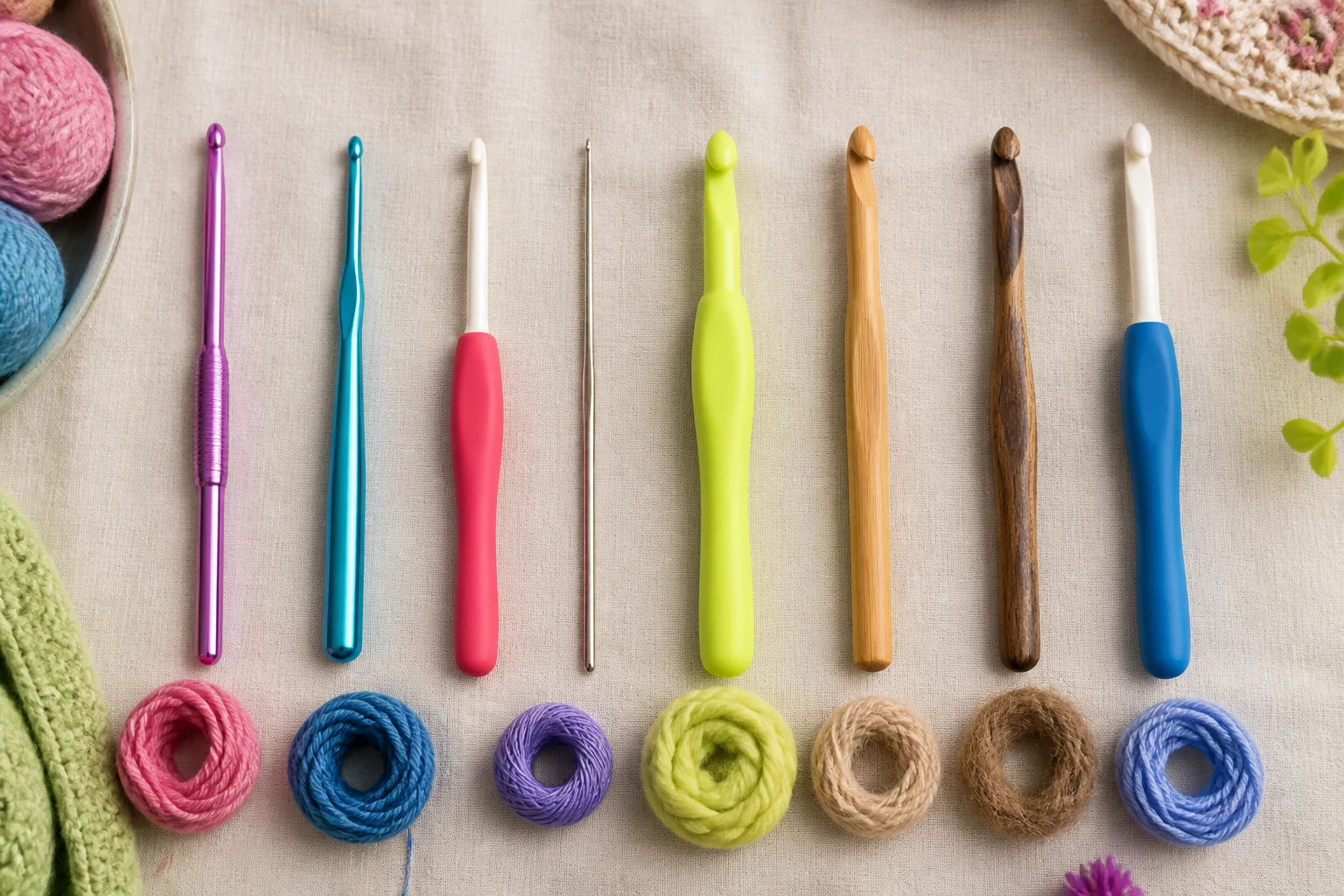
| Category | Defining feature | Common uses | Consideration |
|---|---|---|---|
| Inline | Head and shaft nearly the same width, squared throat | Precise stitch definition, amigurumi | Can feel snug for beginners |
| Tapered | Shaft wider than head, rounded throat | General crochet, faster hand motion | Less uniform stitch shape for some crocheters |
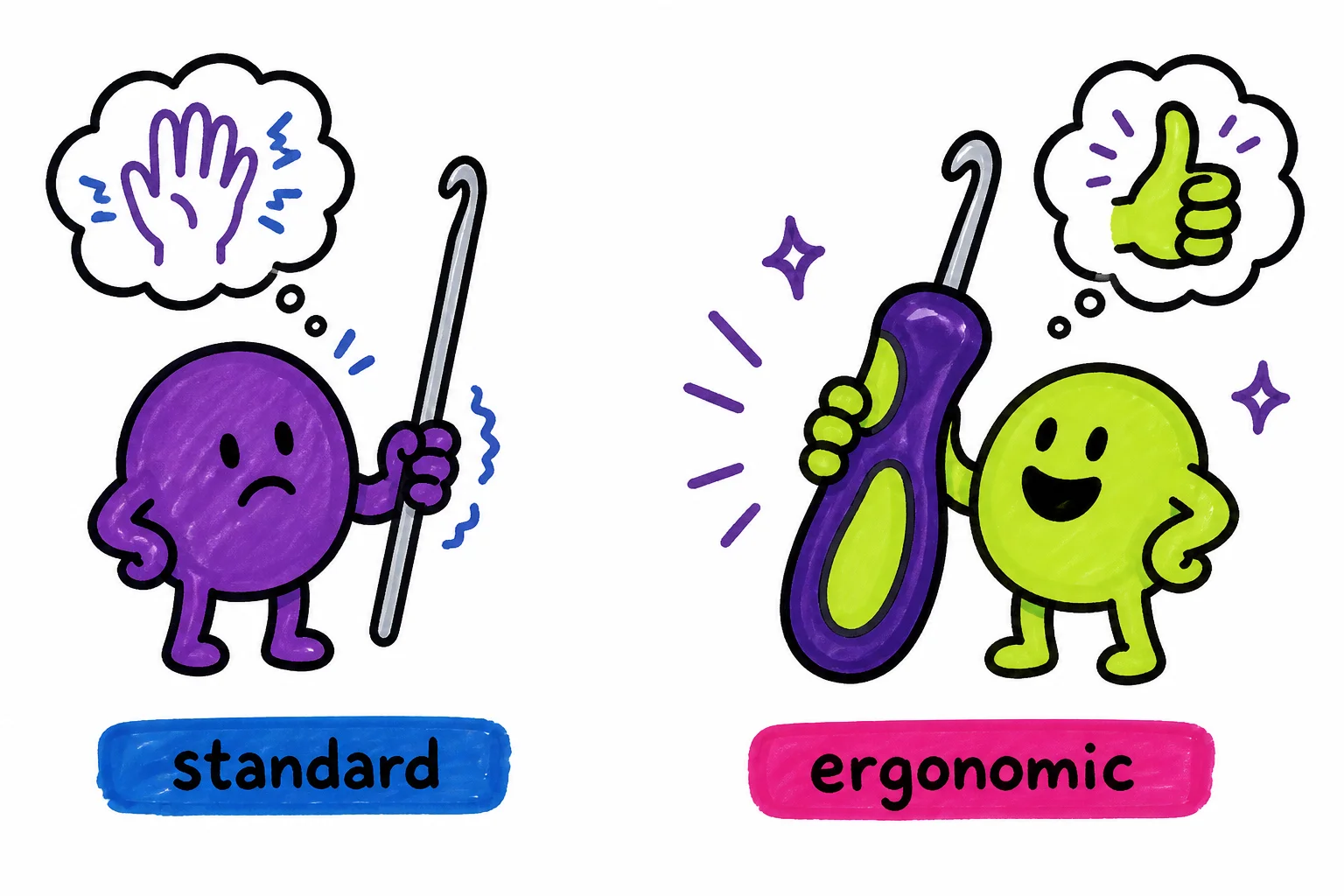
| Ergonomic | Shaped or padded handle | Long sessions, sore hands | Adds bulk, doesn't change the hook head |
| Aluminum | Smooth, durable metal | Everyday yarn crochet | Can feel cold or slippery |
| Steel | Small, thin shafts | Thread and lace work | Sizing runs opposite to regular hooks |
| Plastic | Lightweight, often larger sizes | Bulky yarn, kids' projects | Can flex under tension |
| Bamboo/wood | Warm, slightly grippy surface | Slippery yarns, quieter stitching | Can wear down over years of use |
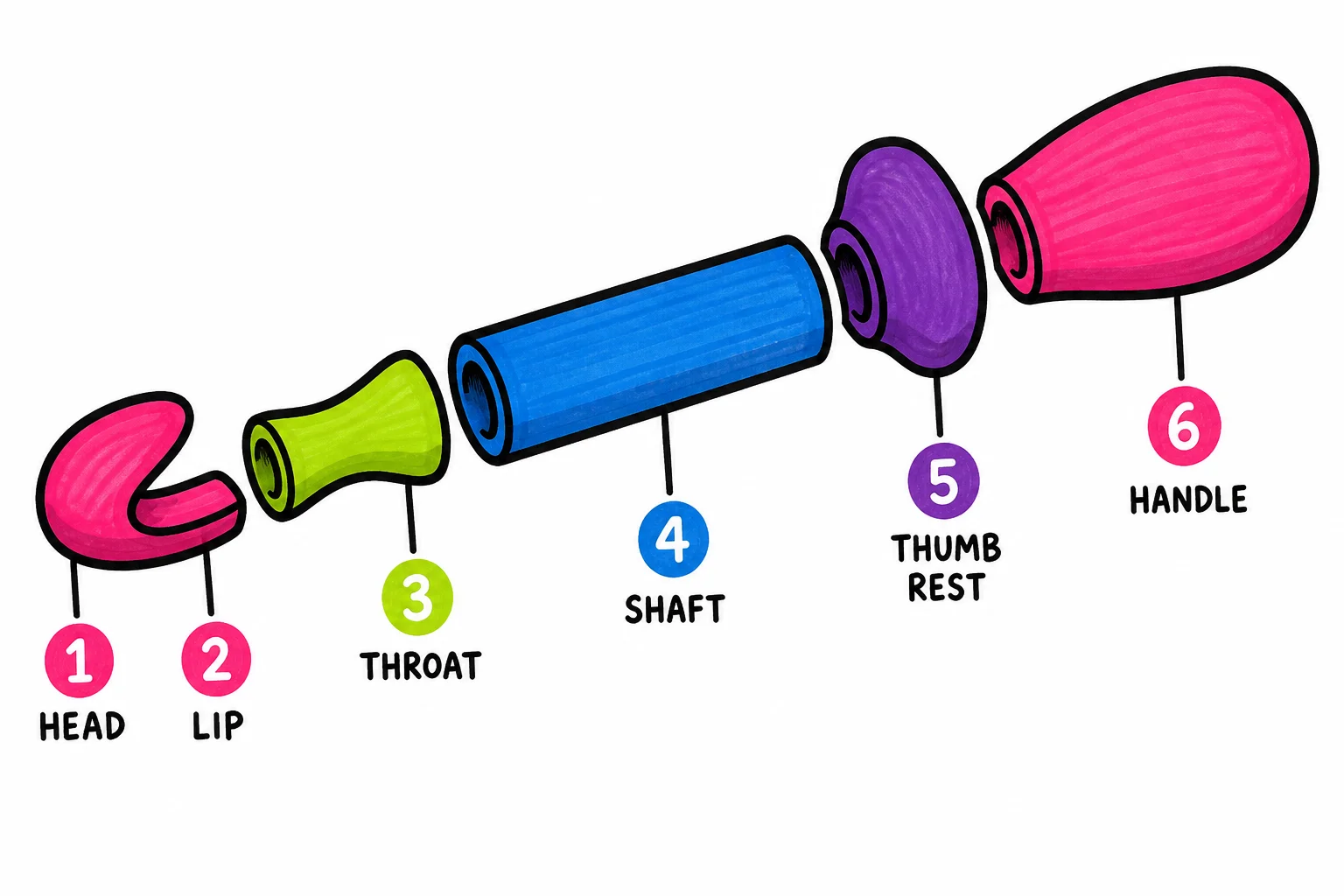
The parts of a hook, from tip to handle
Every hook has the same basic parts, whether it costs two dollars or twenty. Start at the tip and work back.
- Head or point: the tip that pokes through stitches and catches the yarn.
- Lip: the small edge just below the head that keeps yarn from slipping off before you pull it through.
- Throat or neck: the sloped area where yarn actually rests as you draw it through a stitch.
- Shaft or shank: the straight, consistently sized section where your loops sit. Its diameter is what determines the hook's millimeter size.
- Thumb rest: an optional flattened spot for finger placement, not every hook has one.
- Handle: the back section your hand rests on for leverage.
The thumb rest and the handle aren't the same thing. A hook can have a thumb rest with no special handle shaping, or an ergonomic handle with no thumb rest at all.
Inline hooks vs. tapered hooks
Once you know the parts of a hook, the shape question gets easier. Among crochet hooks types, the split most crocheters run into first is inline versus tapered, and it comes down to what happens at the throat.
On an inline hook, the throat stays roughly the same width as the shaft, so the head sits directly in line with the rest of the hook instead of narrowing into it. Picture a cylinder with a groove cut into the tip. Susan Bates hooks are a commonly cited example of this style.
On a tapered hook, the throat narrows gradually from the shaft toward the head, giving the hook a slightly conical look with a shallower dip for catching yarn. Boye hooks are usually pointed to as the classic tapered example, and CrochetKim's guide to Boye hooks describes that narrow neck and shallow throat.

Some crocheters find inline hooks catch yarn more definitely because the deeper groove holds the loop, while others find tapered hooks glide into stitches with less resistance. Neither pattern is guaranteed. How a hook feels also depends on your grip, the yarn you're using, the stitch pattern, and how your hand moves, not the throat shape by itself.
If you can, try one of each before buying a full set. A lot of local yarn shops keep sample hooks out for exactly this reason, and even a Susan Bates hook borrowed from a friend next to a Boye hook from a different friend will tell you more than any chart. Preference here is genuinely personal, and plenty of experienced crocheters switch between both depending on the project.
What your hook is made of matters too
Shape is only half the story. Among the different types of crochet hooks, material changes weight, surface feel, and which projects a hook suits best.
Aluminum is the material most crocheters meet first. It's lightweight, smooth, and affordable, and it covers an enormous range, roughly 2.25 mm to 15 mm and beyond, which spans lace-weight yarn through jumbo. That range makes it a reasonable default for most projects, though the surface can feel cool or a little slick with certain fibers.
Steel hooks are a separate category built for fine thread work. They run from about 0.6 mm to 3.5 mm, sized for doilies, edgings, and other thread crochet rather than standard yarn.
Plastic hooks are light and inexpensive, and they show up most often at the larger end of the size range, useful for chunky or novelty yarns where a heavier hook would tire your hand faster over a long project.
Bamboo and wood hooks add a bit of grip against the yarn instead of a slick glide. Fiber tool guides note this added drag can help with slippery fibers like silk or some acrylics that slide around on metal. Bamboo hooks are commonly found around 3.5 to 8 mm, and wood hooks extend from similar sizes up into jumbo territory.
None of this is a strict rule. Finish quality, the specific yarn fiber, and your own tension all change how any material actually feels in hand, so treat these as starting points rather than guarantees.

Handle shape and grip style are a separate choice from hook shape
Inline versus tapered describes the working end of the hook. Ergonomic describes the handle. The two are independent, so you can find an inline hook with an ergonomic grip, or a tapered hook with one. Kollage's SQUARE hooks, for example, pair an inline aluminum head with a square-shaped ergonomic handle.
Ergonomic handles usually mean a wider, cushioned grip in soft TPR, rubber, silicone, or contoured wood, sometimes with a flat thumb rest built into the shape. The idea is to spread pressure across more of the hand instead of pinching a thin metal shaft. Some crocheters find this easier to hold for long stretches. Others prefer the control of a slim standard hook and never switch.
How you hold either hook is its own decision. The pencil grip rests the shaft between thumb and index finger with the hook resting on top of the hand, similar to holding a pencil. The knife grip brings the handle into the palm, similar to holding a dinner knife. Neither is required, and finger placement varies from person to person within both.
Wider handles are not a medical fix for arthritis or joint pain, whatever a product listing might imply. If your hands ache regularly, take breaks and talk to a doctor or occupational therapist rather than relying on a hook to solve it.
Reading crochet hook sizes in millimeters and US labels
Millimeters measure the actual diameter of the hook shaft, so they are the most reliable number on the package. The Craft Yarn Council points out that since letter and number sizing varies by company, the millimeter marking on the tool is what you should trust first.
US labels stack a letter or number on top of that millimeter measurement, and different crochet hook sizes get grouped under different labels depending on who made the hook. A few common pairings, treated as general convention rather than a fixed rule:
- 2.25 mm is often B-1
- 3.5 mm is often E-4
- 4.0 mm is often G-6
- 5.0 mm is often H-8
- 6.0 mm is often J-10
The full range the Craft Yarn Council lists runs from 2.25 mm up to 30 mm. Even within one letter, sizes can shift slightly between guides, so a G might read 4.0 mm on one chart and 4.25 mm on another.
Steel hooks used for thread work follow their own numbering entirely, and it runs in the opposite direction from regular hooks in some systems, which trips up plenty of beginners moving between yarn and thread crochet.

Start any pattern with the hook size it lists, then confirm the millimeter marking stamped on the hook itself rather than relying on the letter alone. When a project's finished dimensions matter, like a garment or anything with fit, make a gauge swatch: a small test piece worked in your actual yarn and stitch pattern, usually measured over a 4-inch or 10-centimeter area. If your swatch has more stitches than the pattern calls for, size up. Fewer stitches, size down.
Matching a hook to what you're actually making
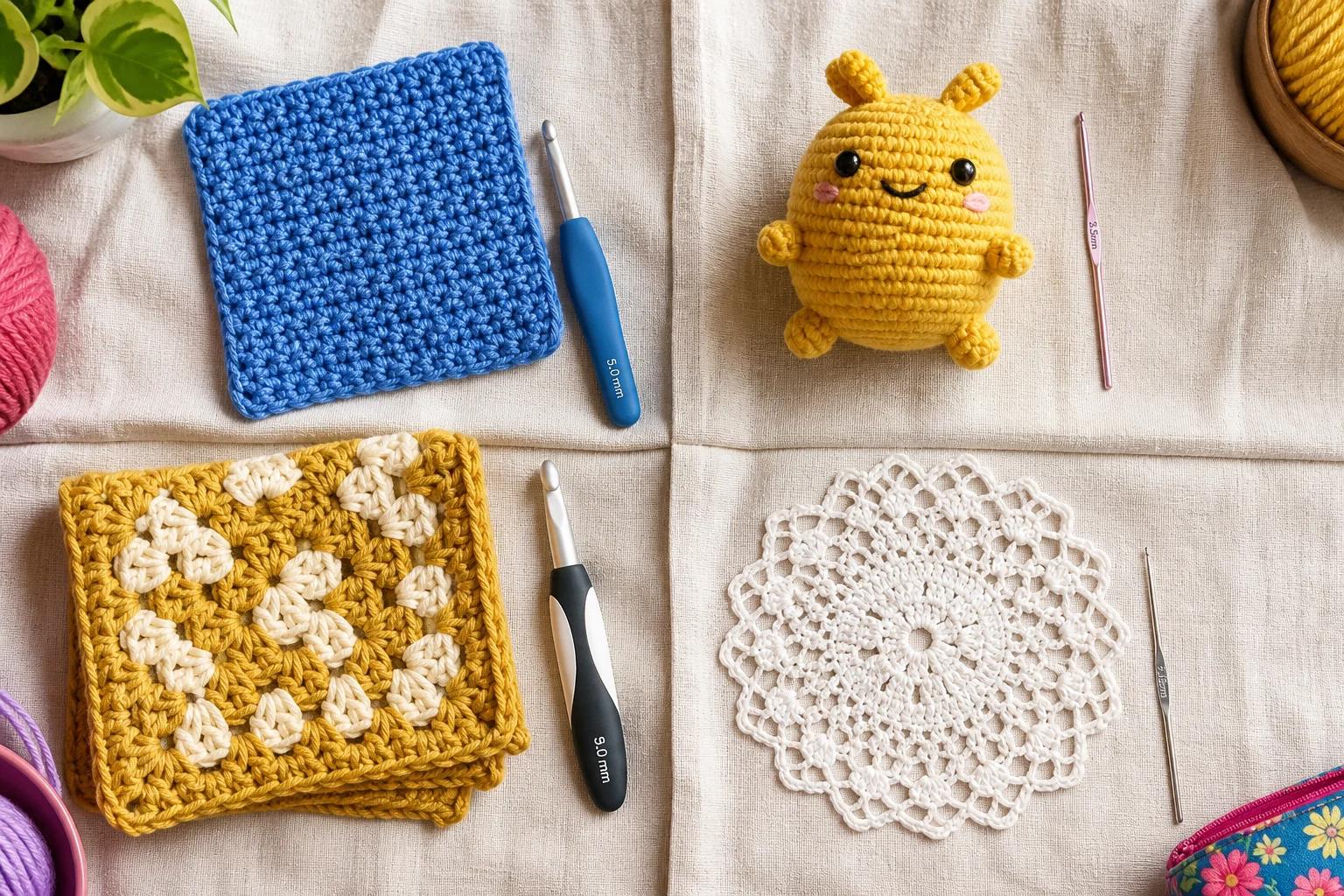
If you're searching different types crochet hooks, you're usually trying to sort overlapping features (shape, material, handle, size) into one decision, not picking from separate categories. Here's how that plays out for four common projects.
For beginners, start with the size your pattern lists, often a 5 mm hook (US H/8) with medium-weight yarn. It's a comfortable middle ground for learning stitches and building rhythm, and the stitches are easy to see. Pick a hook with a clearly stamped size and a shape that feels stable in your hand, whether that's inline, tapered, or ergonomic.
For amigurumi, patterns often call for a hook one to two sizes smaller than the yarn label suggests, since tight stitches keep stuffing from peeking through. Your own gauge still decides the final call.
For blankets, you're working large amounts of yarn over long sessions. Bulky yarn often pairs with 6.0 to 8.0 mm hooks, and a lightweight aluminum hook or a wider ergonomic handle can ease hand strain over hours of repetitive stitching.
For lace or thread crochet, fine steel hooks take over, sized under a separate numbering system that runs opposite to regular hooks in some charts. Check both the hook and thread labels before buying.
Keeping your hooks in good shape and making a final call
Wipe hooks dry after each session and store them where fine tips won't bend. Wood and bamboo shouldn't be soaked; a light wipe with oil beats water. Check plastic or soft-grip handles now and then for cracks.
Before buying: does it match your pattern's mm size, suit your yarn, and fit inline or tapered preference? Does the material and handle feel good for long sessions? Have you swatched for gauge?
Knowing the types of hooks makes choosing simpler, but testing one with your own yarn is the real final check.
Ready to use one? Try a beginner-friendly crochet pattern from Derpy Monster, or browse another guide on the site.

Written by
Adriana Maronese
I’m Adriana, the maker behind Derpy Monster. I love learning, making, and sharing the little discoveries that make crochet feel more joyful.
Keep the making going
What do you feel like making today?
Find your next pattern, collection, or tiny spark of inspiration.